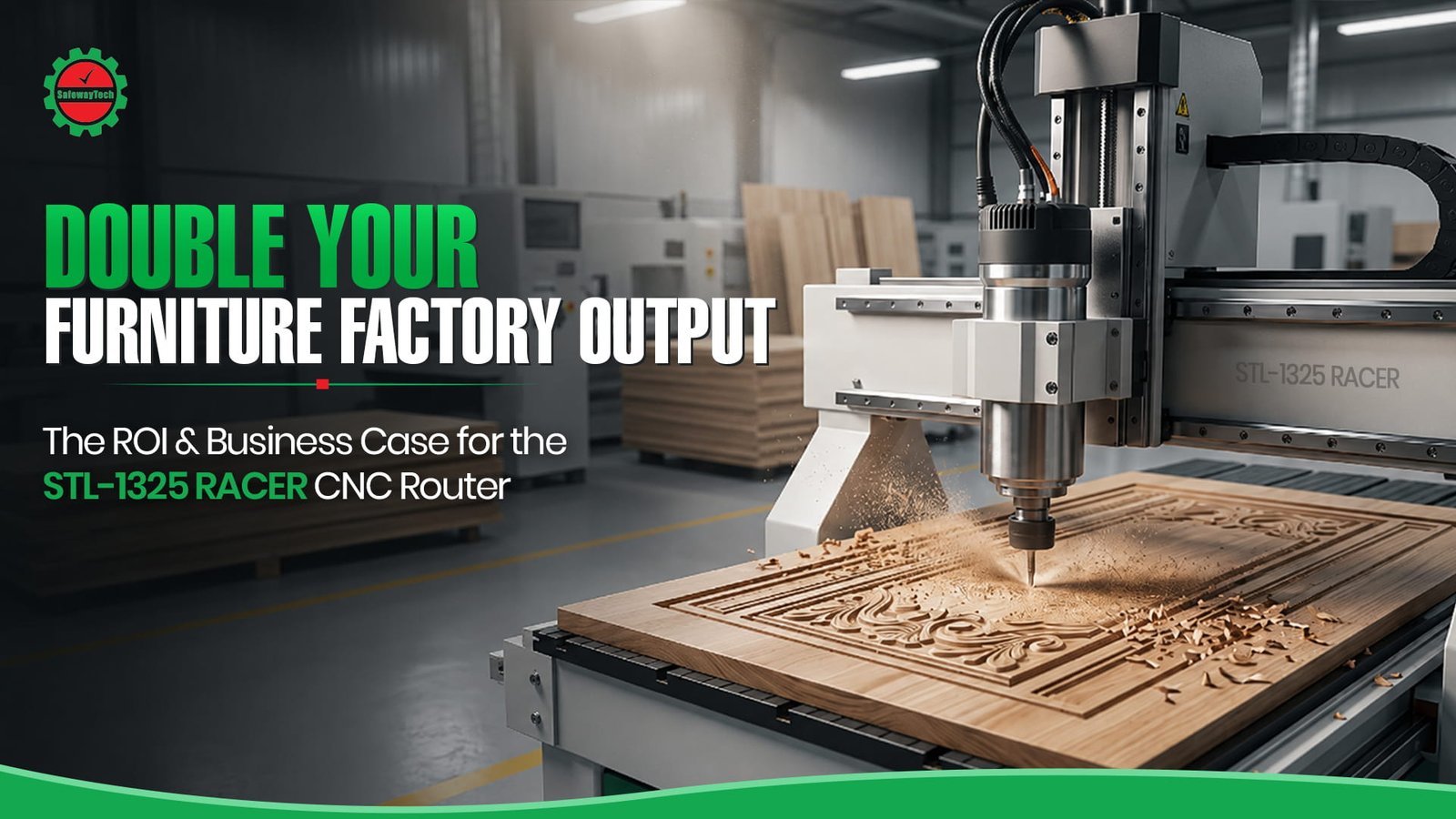
If you’re still running your furniture factory on manual cutting tables, chances are you’ve already done the math on hiring more carpenters and found it doesn’t scale the way you need it to. More workers means more training time, more inconsistency between cutters, and a wage bill that grows faster than your margins. At some point, the question stops being “how many more hands do we need” and becomes “is there a better way to produce.”That’s the question this article answers. The STL 1325 CNC router is one of the most widely adopted automatic wood carving machines among mid-size and growing furniture manufacturers in Bangladesh, and it’s worth understanding not just what it does, but what it’s actually worth to your business.
What the Machine Is, in Plain Terms
Strip away the technical spec sheet and the STL-1325 RACER is a computer-controlled cutting and carving system that takes a digital design file and reproduces it on wood, MDF, plywood, or acrylic – automatically, repeatedly, and to the same tolerance every single time. You design once; the machine executes as many times as your order requires, without a second carpenter needing to interpret the pattern by eye.
The core specification, for anyone comparing options:
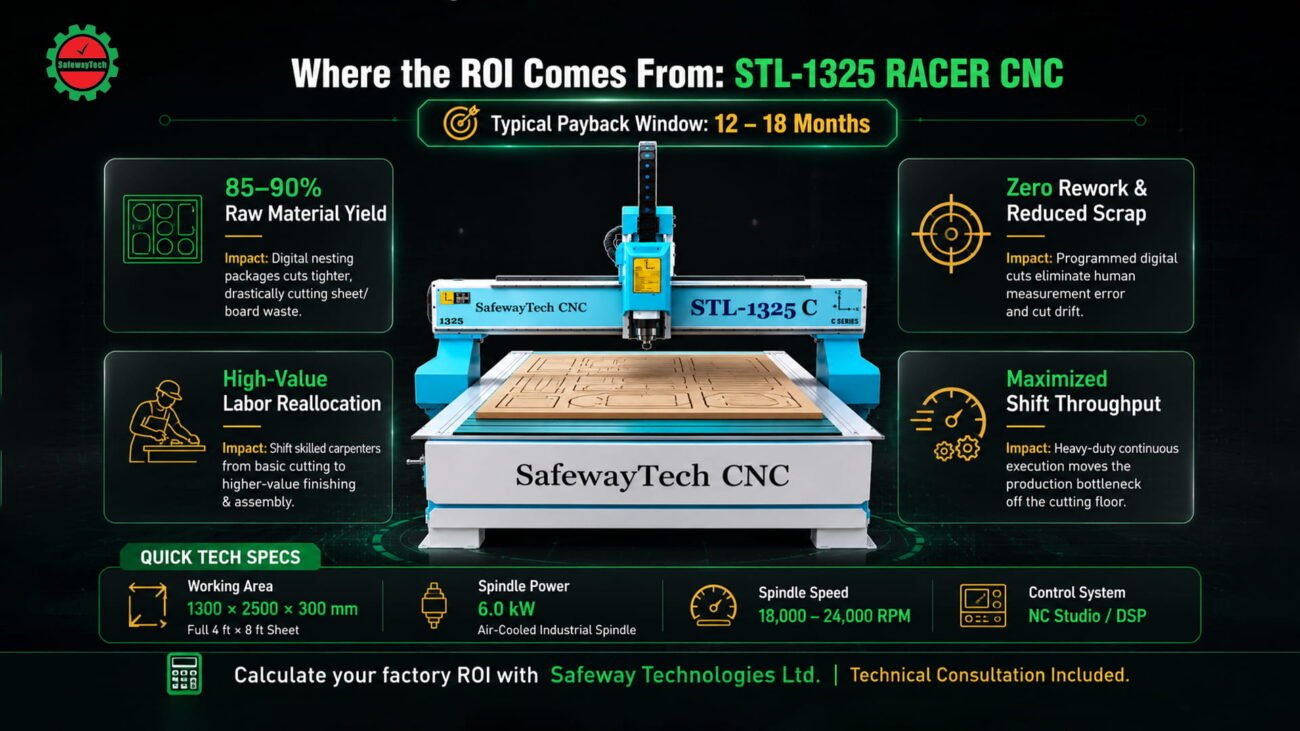
- Working table: 1300 x 2500 x 300mm – a full 4ft x 8ft sheet in one pass
- Spindle: 6.0 KW air-cooled – rated for continuous industrial cutting, not intermittent hobby use
- Frame: Welded steel with 25mm rail across all three axes, built to hold accuracy under daily multi-shift load
- Control system: NC Studio / DSP – a control platform with a shallow learning curve for new operators
- Spindle speed: 18,000–24,000 RPM, tunable to the material being cut
That’s the “what.” The more important question for a factory owner is the “so what” – what does this actually change about your business.
The Business Case: Where the ROI Actually Comes From
Framed purely as furniture factory automation BD decision, the return on a machine like this comes from four measurable places, not from vague “efficiency”:
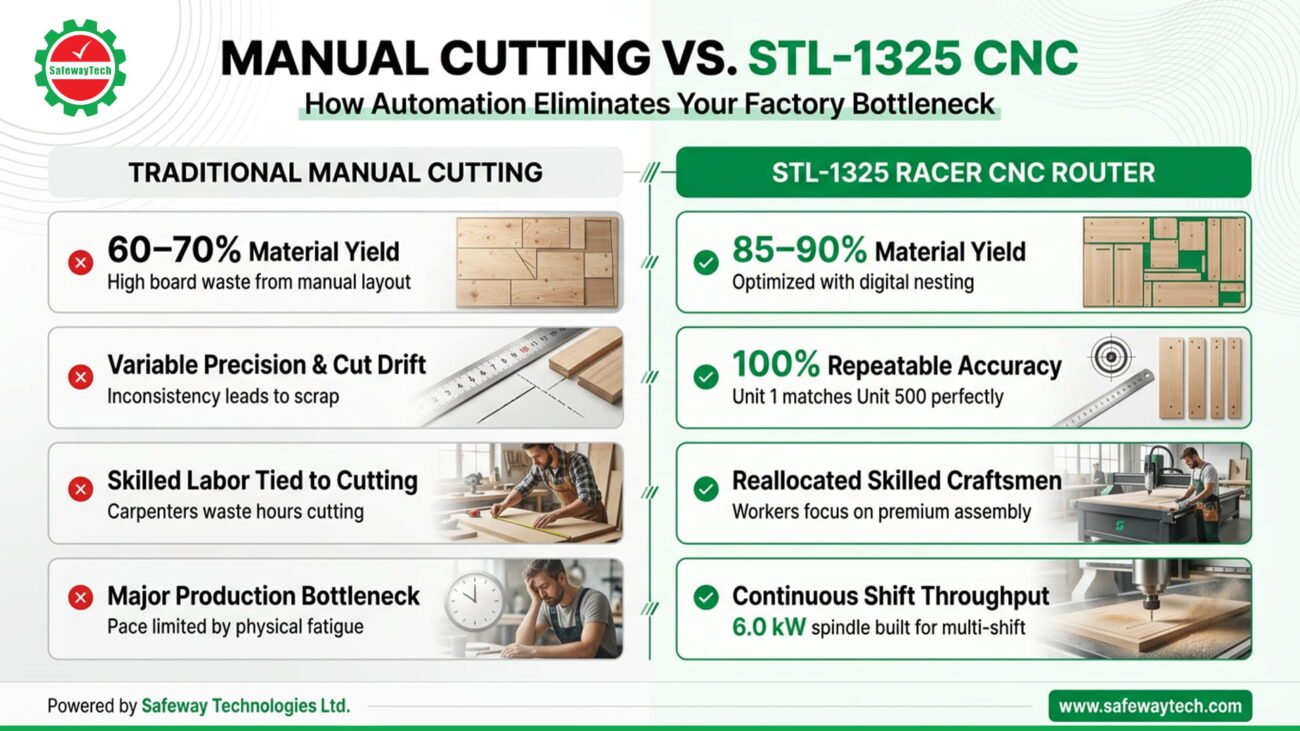
1. Material cost. Digital nesting software packs cutting layouts tighter than a worker eyeballing a sheet ever can. Industry benchmarks for CNC-nested furniture production put raw material yield in the 85–90% range, versus meaningfully lower yield from manual sawing. If board is one of your top three costs – and for most furniture factories it is this single line item can justify a large share of the investment on its own.
2. Labor reallocation, not necessarily labor cuts. The machine doesn’t eliminate your workforce; it moves your most skilled people off repetitive cutting and onto assembly, finishing, and quality checks – the stages where craftsmanship actually shows up in the final product and commands a better price.
3. Rework and rejects. Every hand-cut panel that comes out slightly off-spec is either scrapped or eats labor hours to correct. A programmed cut doesn’t drift between the first unit of the day and the five-hundredth.
4. Throughput per shift. With cutting no longer the bottleneck, the constraint moves to loading, unloading, and downstream assembly – which is a workflow problem you can solve with scheduling, not a hardware problem requiring more capital.
Putting a Number on It
For a mid-size Bangladeshi furniture factory, an investment in this class of machine typically runs around ৳5.5-7.5 lakh, all-in. Based on the combined effect of material savings, reduced rework, and reassigned labor described above, factories in this bracket commonly see payback in the 12–18 month window – with the exact figure depending heavily on your current sheet consumption, reject rate, and order volume. Before you commit, it’s worth pulling your last two quarters of production numbers and running them against a supplier’s projected output figures rather than taking any single “doubles your output” claim -including this one at face value.
Who Should (and Shouldn’t) Make This Move Yet
This machine class is the right next step if:
- Cutting and routing capacity – not sales – is currently limiting how many orders you can accept
- You’re running multiple manual cutting stations for standard sheet-good work
- Your skilled carpenters are spending time on repetitive cutting instead of higher-value finishing
- You have (or can quickly build) the order volume to keep a single machine running near capacity
It’s premature if your factory is still doing low-volume, highly custom one-off pieces where manual flexibility matters more than repeatable throughput – in that case, a smaller machine or a phased rollout makes more financial sense than jumping straight to a full industrial configuration.
The right way to evaluate this isn’t a spec sheet in isolation – it’s mapping a machine’s throughput against your actual order volume and product mix. Safeway Technologies Ltd. supplies and installs the full STL series CNC router and woodworking machinery range in Bangladesh, with free installation and operator training included. If you want a realistic ROI estimate based on your current production numbers rather than a generic projection, reach out to our technical team for a consultation.
For an independent look at what actually drives CNC production capacity beyond the spindle itself, BCAM CNC’s breakdown of production capacity factors is a useful reference.