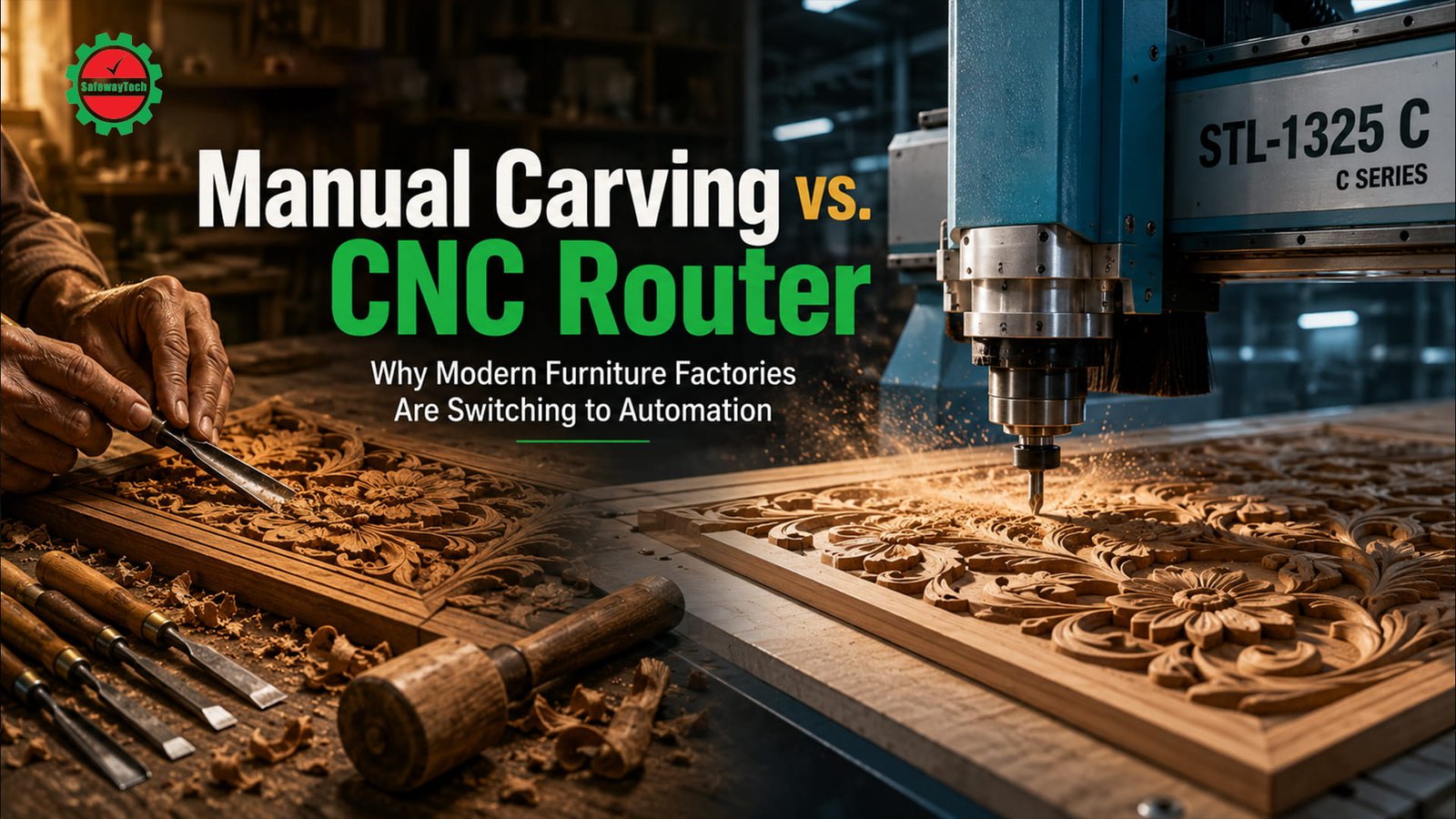
Walk into most established furniture workshops in Bangladesh and you’ll still find rows of workers hand-carving panels, chair legs, and decorative moldings a skill passed down over generations. It produces beautiful work. It also produces inconsistent output, unpredictable delivery timelines, and a business that can’t easily say yes to a large order without a large risk.
Over the past several years, a growing number of factories have added CNC routers alongside and in many cases instead of manual carving stations. This isn’t a rejection of craftsmanship; it’s a recognition that manual and automated methods solve different problems, and knowing which one fits which job is the difference between a factory that scales and one that stays capped at its current size.
How the Two Methods Actually Differ
Manual carving relies entirely on a craftsman’s hand, eye, and years of trained muscle memory. Every cut is unique which is exactly the appeal for one-off heirloom pieces, but exactly the problem when a client orders 200 identical chairs.
CNC (Computer Numerical Control) routing takes a digital design file and executes it with a motor-driven cutting head guided by software, reproducing the same design to the same tolerance every time, whether it’s the first unit or the five hundredth. Modern 3D wood carving machine BD setups can also carve genuine depth and relief detail not just flat cuts closing much of the gap that used to exist between “CNC-cut” and “hand-carved” in terms of visual richness.
Neither approach is universally better. The comparison only makes sense against what a specific order actually needs.
Where Manual Carving Still Wins
It would be dishonest to frame this as CNC replacing manual work across the board. Manual carving remains the right choice when:
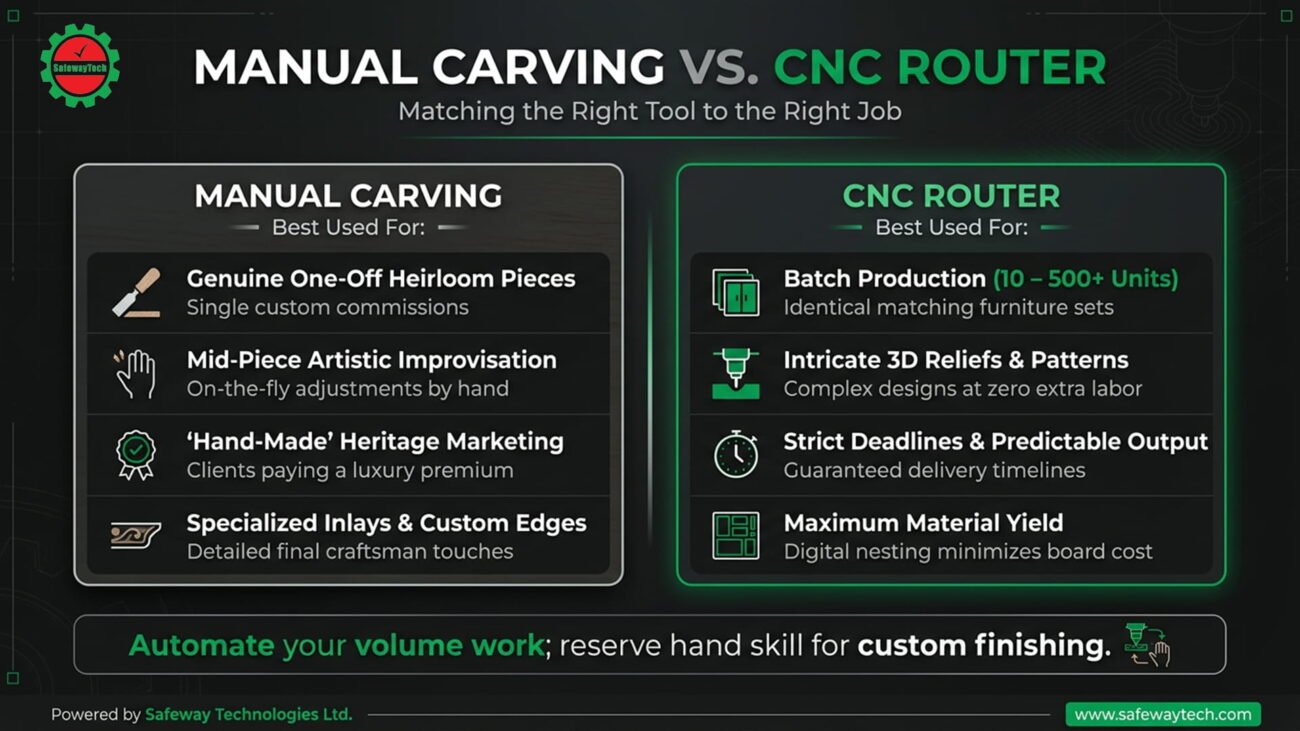
- The piece is a genuine one-off. A single custom commission rarely justifies programming a CNC toolpath.
- The design requires improvisation. A skilled carver can adjust mid-piece in ways a pre-programmed toolpath cannot.
- The market specifically pays for “hand-carved.” Some buyers, particularly in high-end or heritage furniture segments, pay a premium precisely because it’s not machine-made.
Where a Wood Carving Machine vs. Manual Comparison Clearly Favors CNC
For most day-to-day factory production, though, the comparison tilts hard toward automation, for reasons that show up directly on the factory floor:
Consistency across a batch. When an order calls for 50 or 500 identical units, a CNC router delivers unit #1 and unit #500 to the same tolerance. Manual carving, however skilled the carver, introduces natural variation fine for a single art piece, a liability for a matched furniture set.
Speed at volume. A single CNC router can process cutting and carving work that would otherwise require several manual carving stations running in parallel, freeing skilled carpenters for assembly and finishing instead of repetitive cutting.
Material efficiency. Digital nesting software lays out cutting patterns across a sheet to minimize waste something that’s difficult to replicate by eye at scale, and directly reduces your board cost per unit.
Design complexity without added labor cost. Intricate relief patterns, lattice work, and repeated motifs that would take a carver hours per unit take a CNC router the same programmed time regardless of pattern complexity, once the toolpath is set.
Predictable lead times. Manual output depends on how many trained carvers you have available on a given day. CNC output is a function of machine hours, which is far easier to plan a production schedule and a delivery date around.
The Real-World Model: Hybrid, Not Either/Or
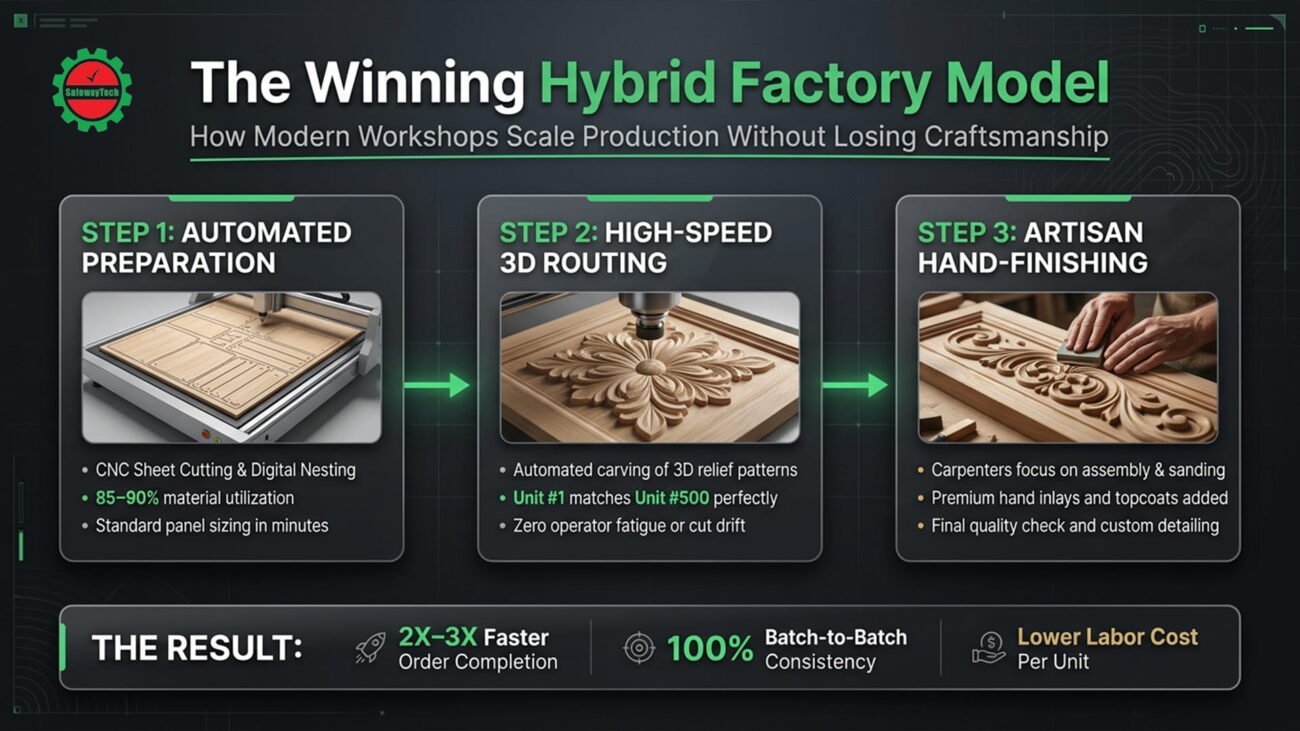
The factories seeing the strongest results generally aren’t choosing one method exclusively they’re using CNC routers for repeatable structural cutting, panel work, and standardized carving patterns, then bringing manual craftsmanship in for finishing touches, custom inlays, or client-specific detailing that a catalog design doesn’t cover. This hybrid model captures the volume and consistency benefits of automation without abandoning the craftsmanship that differentiates a premium product.
This is also the more realistic path for most Bangladeshi manufacturers rather than a wholesale switch: start by automating your highest-volume, most-repeated cutting and carving tasks, and keep manual capacity for the custom and premium end of your product line.
What This Means for Modern Furniture Manufacturing Technology in Bangladesh
As export orders and domestic demand both push toward tighter delivery timelines and larger batch sizes, the factories adapting fastest are the ones treating CNC adoption as modern furniture manufacturing technology infrastructure – not a one-time equipment purchase, but a shift in how production is planned. That shift typically starts with identifying which specific products in your current catalog are high-volume and repeatable enough to justify programming a toolpath, then automating those first.
Choosing the Right Machine for Your Mix
If you’re weighing this decision for your own factory, the right starting point isn’t “CNC or manual” as an abstract choice; it’s an honest look at your last six months of orders: how many were one-off custom pieces versus repeated standard designs. That ratio tells you how much CNC capacity actually makes sense for your specific product mix.
Safeway Technologies Ltd. supplies and installs a full range of CNC router and 3D wood carving machines for furniture manufacturers across Bangladesh, with installation and operator training included. If you’d like help mapping your order mix against the right machine configuration, contact our technical team for a consultation.
For a deeper technical comparison of CNC carving capability against traditional woodworking methods, Thermwood’s overview of CNC routing in furniture production is a useful independent reference.